There are six common types of tow trucks: flatbed, wheel lift, hook and chain, integrated wrecker, boom truck, and rotator. Each type works a little differently and is designed for particular vehicles, locations, and recovery situations.
For most everyday cars and SUVs, towing usually comes down to a flatbed or wheel-lift truck. More specialized equipment is needed when a vehicle is badly damaged, stuck off the road, difficult to access, or too large for a standard tow truck.
Understanding the differences can give you a better idea of what to expect when you call for towing and why the dispatcher may ask several questions about your vehicle before sending a truck.
What Are the Different Types of Tow Trucks?
Here is a quick comparison of the six main tow truck types.
| Tow Truck Type | How It Works | Common Uses |
| Flatbed or rollback | Carries the entire vehicle on a hydraulic platform | Cars, SUVs, AWD vehicles, damaged vehicles, long-distance transport |
| Wheel lift | Lifts either the front or rear wheels with a metal yoke | Short-distance towing, tight spaces, parking areas |
| Hook and chain | Uses chains to lift part of the vehicle | Junk, scrap, and severely damaged vehicles |
| Integrated wrecker | Combines lifting, winching, and towing equipment | Larger vehicles and demanding recovery work |
| Boom truck | Uses a boom and winch to reach difficult locations | Ditches, embankments, off-road recovery |
| Rotator | Uses a rotating heavy-recovery boom | Large commercial vehicles and complex accident recovery |
The right equipment depends on several factors, including the type of vehicle, drivetrain, condition, accessibility, and the kind of recovery required.
1. Flatbed Tow Truck
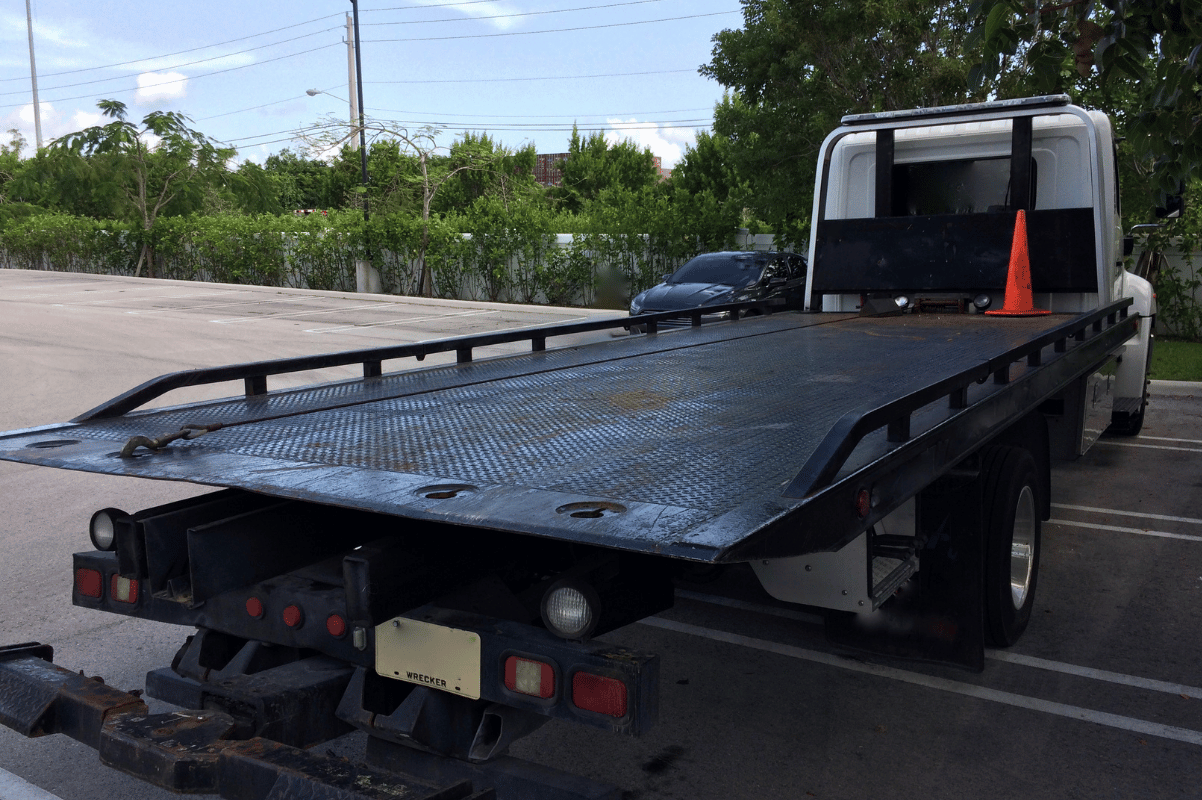
A flatbed tow truck, sometimes called a rollback, has a large platform mounted behind the cab. The bed tilts down toward the ground so the disabled vehicle can either be driven or winched onto it. Once the vehicle is secure, the platform moves back into its transport position.
Unlike towing methods that leave two wheels in contact with the road, a flatbed carries the entire vehicle. This makes flatbed towing especially useful when minimizing road contact is important. It is commonly used for accident-damaged cars, low-clearance vehicles, long-distance towing, and vehicles whose manufacturers recommend transportation with all four wheels off the ground.
When Is a Flatbed Tow Truck Best?
A flatbed may be the right choice when:
- The vehicle cannot roll normally
- The car has accident damage
- The vehicle has very low ground clearance
- A longer-distance tow is required
- The manufacturer specifies flatbed transport
- You want all four wheels kept off the road
Flatbed towing is also commonly recommended for certain AWD and electric vehicles, although vehicle-specific instructions should always be followed. If you drive an EV, it is especially important to understand why you can’t tow an electric car on a dolly. Tesla, for example, states that several of its vehicles should be transported on a flatbed or comparable transport vehicle, while Subaru warns that improper towing can damage AWD systems.
2. Wheel-Lift Tow Truck
A wheel-lift tow truck uses a strong metal yoke that fits beneath either the front or rear wheels of a vehicle. A hydraulic system then lifts those wheels while the opposite pair remains on the road during transport.
Because wheel-lift trucks are relatively compact, they can often reach places where a larger flatbed would be difficult to position. That makes them particularly useful for short-distance towing and locations with limited access, such as narrow parking areas, busy streets, and some parking garages.
Flatbed vs. Wheel Lift Tow Truck
For ordinary passenger vehicles, flatbeds and wheel lifts are two of the most common options. A flatbed carries the entire vehicle, keeping all four wheels off the road and providing greater separation between the vehicle and the pavement. A wheel lift, on the other hand, is more compact and can be easier to use when space is limited.
The correct choice depends heavily on the vehicle’s drivetrain and manufacturer recommendations. If you drive an AWD, 4WD, hybrid, or electric vehicle, make sure the dispatcher knows before a truck is sent. Not every towing method is suitable for every drivetrain.
3. Hook-and-Chain Tow Truck
The hook-and-chain tow truck is one of the older towing designs. Chains are attached to suitable points on the vehicle, allowing one end to be lifted while the other wheels remain on the road.
Although this method was once widely used, it is rarely the preferred option for modern passenger vehicles because chains can put pressure on vehicle components and may damage exterior surfaces. Today, hook-and-chain trucks are more commonly associated with junk vehicles and scrap removal, and severely damaged vehicles where cosmetic condition is no longer the main concern.
This is one reason it is important to explain the condition of your vehicle when you call a towing company. A car with a simple mechanical breakdown may require very different equipment from one that has been heavily damaged in a collision.
4. Integrated Tow Truck or Wrecker
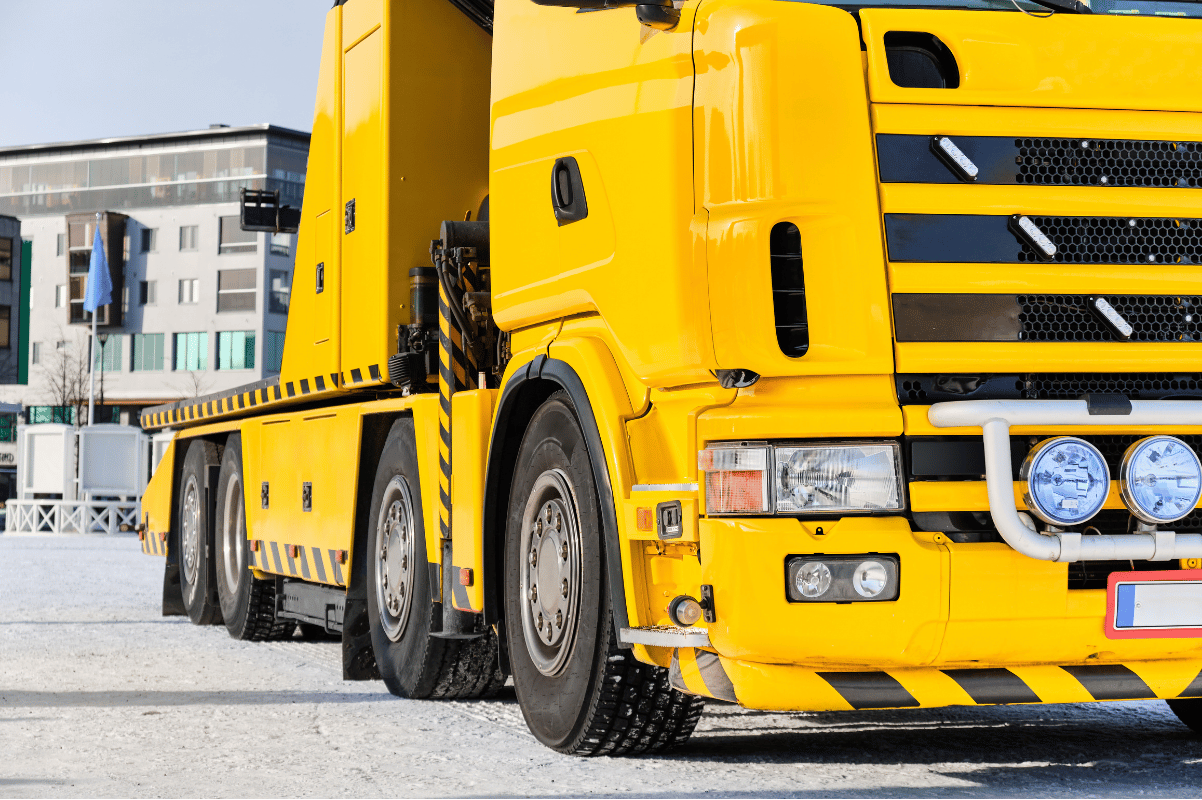
An integrated tow truck, often called a wrecker, combines several towing and recovery functions into a single vehicle. Depending on its setup, it may include a wheel-lift system, boom, winches, reinforced towing components, and additional axles.
Integrated wreckers are generally used for more demanding jobs than a typical passenger vehicle tow. Their greater lifting and pulling capability makes them useful for larger commercial vehicles and difficult recovery situations.
In other words, a passenger car with a straightforward mechanical problem normally does not need the same type of equipment as a bus, commercial truck, or heavily damaged vehicle.
5. Boom Tow Truck
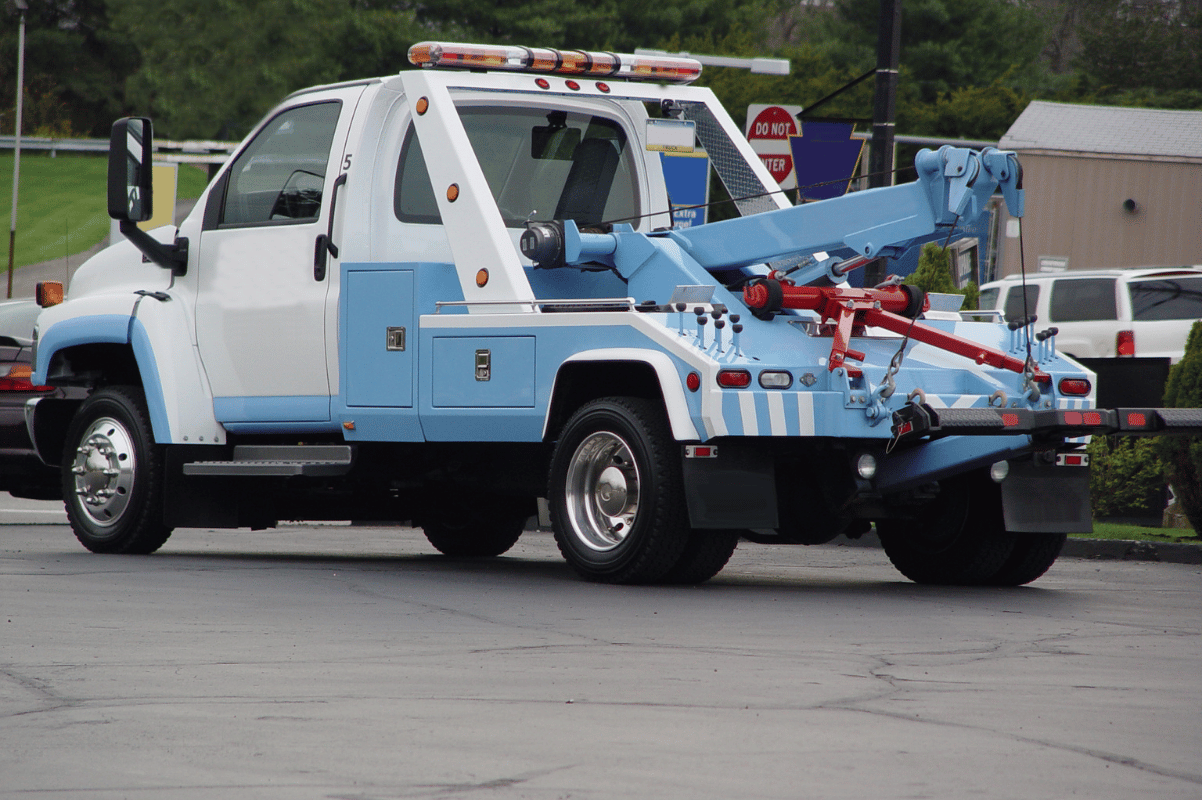
A boom tow truck is primarily designed to recover vehicles that cannot easily be reached from the roadway. Its boom extends outward and works with a winch system to pull or lift a vehicle from a difficult position.
A boom truck may be useful when a vehicle has:
- Slid into a ditch
- Gone down an embankment
- Become stuck away from firm pavement
- Stopped somewhere a standard tow truck cannot safely approach
Because of this, boom trucks are especially valuable for vehicle recovery rather than ordinary point-to-point towing. Once the vehicle has been brought back to a safe and accessible position, the same truck or another suitable tow truck may transport it to its destination, depending on the circumstances.
6. Rotator Tow Truck
A rotator tow truck is specialized heavy-recovery equipment designed for difficult and large-scale recovery situations. Its boom can rotate around the truck, allowing trained operators to lift or reposition heavy loads without having to place the recovery vehicle directly in front of them.
Rotators are generally used for large commercial vehicles, rollovers, major collision scenes, and situations where conventional recovery equipment cannot operate effectively.
Most drivers dealing with an ordinary car breakdown will never need a rotator. These trucks sit at the heavy-recovery end of the towing industry rather than being used for routine roadside towing.
Which Type of Tow Truck Do You Need?
In most cases, you do not need to figure this out yourself. A professional towing dispatcher can select the appropriate equipment after learning what kind of vehicle you have, what happened, and where the vehicle is located.
For a standard car or SUV, a flatbed or wheel lift may be suitable. A badly damaged vehicle or one with specific drivetrain requirements may need a flatbed, while a vehicle that is stuck off the road could require recovery equipment before it can even be transported.
Larger commercial vehicles and serious recovery situations may require specialized heavy-duty equipment. The most helpful thing you can do is give the dispatcher accurate information from the start.
What Should You Tell the Towing Dispatcher?
Before sending a tow truck, the dispatcher may need to know:
- Your exact location
- Your vehicle’s make, model, and approximate year
- Whether it is front-wheel drive, rear-wheel drive, AWD, or 4WD, if known
- Whether it is a hybrid or electric vehicle
- What happened to the vehicle
- Whether the wheels can roll
- Whether there is visible accident damage
- Whether the vehicle is in a garage, ditch, narrow driveway, or another restricted location
- Where you want the vehicle taken
Providing these details helps the towing company choose suitable equipment before leaving for the call, which can reduce unnecessary delays. Guidance from other towing providers also commonly emphasizes location, vehicle information, drivetrain, vehicle condition, and destination as useful dispatch details.
Do You Actually Need a Tow Truck?
Not every roadside problem requires a tow. If your vehicle is in a safe location and has not suffered serious mechanical or collision damage, roadside assistance in Halifax may be enough to get you moving again.
For example, a dead battery may only require a battery boost, an empty fuel tank may be solved with fuel delivery in Halifax, and a flat tire may simply need a flat tire change.
Towing becomes more appropriate when the vehicle cannot be made safely driveable at the roadside, has significant accident damage, has a serious mechanical problem, or needs to be transported to another location. Knowing the signs you need a tow truck instead of roadside assistance can make that decision easier.
Calling a company that provides both roadside assistance and towing can make the process easier because you can explain what happened first and let the operator determine which service is actually needed.
Why the Correct Tow Truck Matters
Choosing the right towing equipment involves more than simply getting a vehicle from one place to another. The proper setup can help protect the drivetrain, wheels, suspension, bodywork, and other vehicle components during loading and transportation.
The location of the vehicle matters too. A car stuck inside a parking garage presents very different access challenges from one that has left the roadway, while a small sedan requires different equipment from a large commercial truck.
Vehicle manufacturers may also specify approved transportation methods for certain models or drivetrains. Whenever there is uncertainty, the owner’s manual and manufacturer towing instructions should be taken into account.
Towing and Roadside Assistance in Halifax, NS
You do not need to memorize every type of tow truck before asking for help. When you call Halifax Towing Service – NST, simply explain where you are, what kind of vehicle you have, and what happened. From there, the goal is to determine whether you need towing service in Halifax or a roadside service such as a battery boost, fuel delivery, or tire change.
Halifax Towing Service – NST provides 24/7 emergency towing and roadside assistance, including flatbed towing, long-distance towing, battery boosts, fuel delivery, tire changes, and junk car buying.
For towing or roadside assistance in Halifax, NS and surrounding areas, call +1 902-989-4848.
Halifax Towing Service – NST
301 Lacewood Dr
Halifax, NS B3M 4L1
Canada
Frequently Asked Questions About Tow Truck Types
What are the main types of tow trucks?
The six common types are flatbed, wheel lift, hook and chain, integrated wrecker, boom truck, and rotator. Flatbeds and wheel lifts commonly handle passenger vehicles, while boom trucks, wreckers, and rotators are generally used for more specialized recovery work.
What is the most common type of tow truck?
Flatbed and wheel-lift trucks are among the most commonly encountered types for passenger vehicle towing. Flatbeds carry the entire vehicle on a platform, while wheel lifts raise one pair of wheels and leave the other pair in contact with the road.
Is a flatbed tow truck better than a wheel lift?
Neither option is automatically better in every situation. A flatbed keeps all four wheels off the road and is often preferred when vehicle protection or drivetrain requirements are especially important. A wheel lift is more compact and may be better suited to short-distance towing or locations with restricted access.
Can an AWD vehicle be towed with a wheel lift?
It depends on the vehicle and the towing setup. Some AWD vehicles require all four wheels to remain off the road during transportation. Always check the manufacturer’s towing instructions and tell the towing company that the vehicle is AWD before a truck is dispatched. Subaru, for example, warns that improper towing can damage its AWD system.
Are hook-and-chain tow trucks still used?
Yes, although their role is much more limited than it once was. They are generally better suited to junk, scrap, or severely damaged vehicles because chains can damage the bodywork and components of modern vehicles. Flatbeds and wheel lifts are usually more appropriate for normal passenger vehicles.
How do I know which tow truck to request?
Tell the towing company what kind of vehicle you have, its drivetrain if you know it, its condition, your exact location, and what happened. A professional dispatcher can use that information to choose suitable equipment. If your owner’s manual specifies a particular towing method, mention that when you call.