

Is it safe to drive in a snowstorm? Not always. If heavy snow, ice, poor visibility, or rapidly worsening road conditions make it difficult to control your vehicle or see clearly, the safest choice is usually to delay the trip.
That advice is especially important during Atlantic Canadian winters, when snow, freezing rain, slush, and changing temperatures can affect road conditions quickly.
If you must travel, preparation matters. Check road conditions before leaving, reduce your speed, increase your following distance, use winter tires, and be ready to stop somewhere safe if conditions become worse.
For drivers in Halifax, NS, the most useful question is not simply whether the road is open. You need to know what the road surface, visibility, weather, and your own vehicle are telling you.
When Is It Too Dangerous to Drive in Snow?
You should seriously consider staying off the road when any of the following apply:
- Visibility is so poor that you cannot clearly see traffic, lane markings, signs, or hazards ahead.
- The road is covered with ice or packed snow and your vehicle struggles for traction.
- Freezing rain is occurring or expected along your route.
- Authorities advise motorists to avoid unnecessary travel.
- Roads are closed or conditions are deteriorating quickly.
- Your tires, brakes, wipers, lights, battery, or defroster are not ready for winter driving.
- You do not feel confident controlling the vehicle in the current conditions.
Nova Scotia’s winter-driving guidance recommends avoiding travel during severe winter weather when possible and checking provincial road conditions before leaving.
There is no appointment, errand, or routine trip worth taking unnecessary risks for. Delaying a drive can also give road crews more time to clear and treat major routes.

Check Nova Scotia 511 Before You Leave
One of the best ways to decide whether it is safe to drive is to check 511 Nova Scotia before starting your trip.
The service provides road conditions, closures, incidents, traffic information, highway cameras, weather information, and visibility reports.
Pay attention to the terminology used in road reports.
Bare
A road reported as bare may be mostly dry or wet, but patches of snow or ice can still be present. Do not assume “bare” means completely free of winter hazards.
Partly Covered
Part of the driving surface may contain snow, packed snow, or ice. Traction can change quickly as your tires move between bare pavement and covered sections.
Covered
A covered road means all wheels of a passenger vehicle are expected to be travelling on snow or ice. This requires much greater caution and may be a good reason to postpone non-essential travel.
Poor Visibility
Nova Scotia 511 defines poor visibility as conditions that may suddenly reduce how far you can see to less than 250 metres in some locations.
Never treat a “No Report” listing as confirmation that a road is safe. Nova Scotia 511 specifically notes that adverse conditions may still exist when no report is available.
Why Winter Roads Can Become Dangerous So Quickly
Snow is only part of the problem.
Drivers also need to account for ice, slush, visibility, temperature, braking distance, traffic, and changing road surfaces.
Black Ice Can Be Difficult to See
Black ice may look similar to ordinary pavement. Nova Scotia advises drivers to watch for it when temperatures are near freezing.
Bridges, overpasses, shaded sections, and other exposed surfaces deserve particular attention because ice can develop there even when nearby pavement appears manageable.
If the road suddenly looks unusually glossy or your steering feels lighter than expected, avoid abrupt braking, acceleration, or steering.
Stopping Takes More Time
A vehicle cannot stop on snow or ice the way it can on dry pavement.
Nova Scotia’s driver’s handbook gives a useful example. At 30 km/h, approximate stopping distance is 6 metres on dry pavement, 22 metres on packed snow, and 52 metres on black ice.
That difference is why following distance matters so much.
Do not wait until the vehicle ahead begins braking before deciding what to do. Look well ahead for intersections, traffic lights, curves, pedestrians, stopped vehicles, and changing road surfaces.
How to Drive More Safely When Travel Is Necessary
If conditions are manageable and you genuinely need to drive, change the way you operate the vehicle.
Slow Down Before You Need To
The posted speed limit is designed for favourable conditions. It is not a recommended speed for an icy or snow-covered road.
Reduce your speed before reaching curves, hills, intersections, bridges, and areas where visibility is limited.
Driving more slowly gives you additional time to recognize a hazard and reduces the amount of traction required when turning or stopping.
Leave Much More Space Ahead
Increase the distance between your vehicle and the one in front.
The goal is to give yourself enough room to slow gradually rather than having to brake hard. Transport Canada specifically recommends leaving more distance than normal because stopping takes longer on slippery roads.
If someone is following too closely behind you, do not speed up simply to create distance. Maintain a controlled speed and allow the other driver to pass when it can be done safely.
Make Every Input Smooth
Sudden movements can overwhelm the limited traction available between your tires and the road.
Accelerate gently.
Steer smoothly.
Begin slowing early.
Avoid sharp lane changes.
If your vehicle has ABS and you need to brake hard, use firm, steady brake pressure while continuing to steer as needed. Review your owner’s manual so you understand how your vehicle’s braking and stability systems operate.
Do Not Use Cruise Control on Slippery Roads
Cruise control is useful on dry highways but should not be relied on when traction is uncertain.
Transport Canada advises against using cruise control in extreme winter weather, and Nova Scotia gives similar guidance for slippery conditions.
Keeping direct control of the accelerator makes it easier to respond when grip changes.
Use Winter Tires on All Four Wheels
Good tires do not make dangerous conditions safe, but they can significantly improve your ability to accelerate, steer, and stop.
Transport Canada recommends winter tires on all four wheels for cold, snowy, and icy conditions. Winter tires remain more flexible at low temperatures and use tread designs intended to provide better winter traction.
Transport Canada also notes that all-season and summer tires begin losing elasticity below about 7°C.
For winter use:
- Install four matching winter tires rather than mixing tire types.
- Check pressure regularly because cold temperatures can reduce tire pressure.
- Inspect tread condition before winter.
- Replace tires that are too worn for reliable snow traction.
Transport Canada advises against using winter tires worn close to 4 mm of tread depth on snow-covered roads.
All-wheel drive or four-wheel drive does not remove these requirements. Those systems may help a vehicle move forward, but tire grip still determines how effectively it can corner and stop.
Clear the Entire Vehicle Before Driving
Scraping a small opening in the windshield is not enough.
Remove snow and ice from:
- Windshield and rear window
- Side windows and mirrors
- Headlights and taillights
- Roof
- Hood
- Licence plate where required
Transport Canada recommends clearing the entire vehicle because accumulated snow can obstruct your own view or slide and blow onto surrounding traffic.
Also make sure your windshield washer reservoir contains winter-grade fluid and that your wipers, heater, and defroster are working properly.
What Should You Keep in Your Car During Winter?
A winter emergency kit becomes important when a short drive turns into a long roadside delay.
Useful items include a flashlight, warm clothing, blankets, an ice scraper, snow brush, small shovel, first-aid supplies, phone charging cable, drinking water, non-perishable food, and reflective warning equipment.
Transport Canada also recommends carrying emergency supplies and keeping a charged phone available.
Before longer winter trips, check your battery, tires, brakes, coolant, heater, lights, and windshield-washer system.
What Should You Do If Your Car Gets Stuck in Snow?
First, determine whether the vehicle is in immediate danger.
If you are stopped in an active traffic lane or another location where a collision is possible, call 911 when there is an immediate safety emergency.
If the vehicle is safely off the travelled portion of the road, avoid repeatedly spinning the tires. Excessive wheelspin can dig the vehicle deeper into snow and may make recovery more difficult.
You can carefully clear loose snow from around the tires if it is safe to exit the vehicle. Do not stand close to moving traffic.
If the vehicle will not move without aggressive acceleration, stop trying and request roadside assistance or towing.
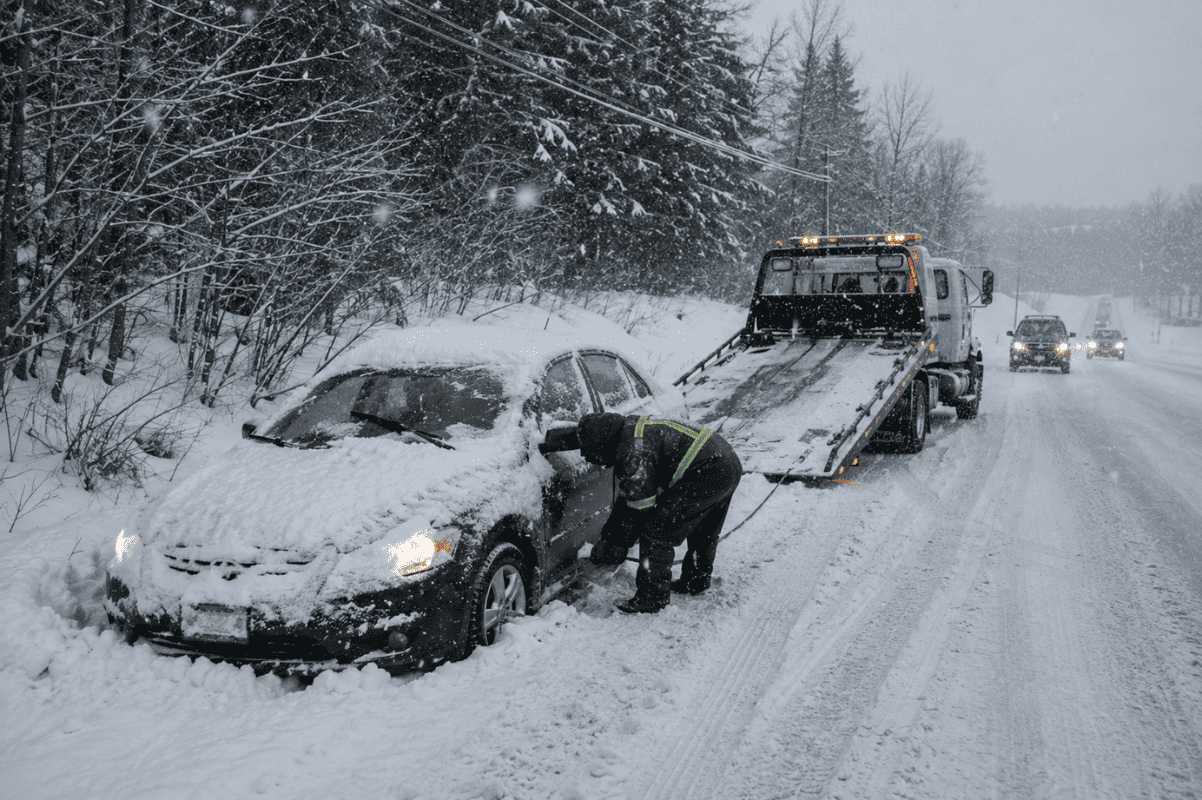
If You Are Stranded for an Extended Period
When leaving the vehicle would expose you to greater danger, staying with the vehicle can provide shelter and make it easier for rescuers to find you.
Transport Canada advises stranded motorists to remain inside when the vehicle is not at risk of being struck, particularly when leaving would expose them to severe weather. It also recommends keeping the exhaust pipe clear of snow because a blocked tailpipe can allow carbon monoxide to enter the vehicle.
Keep your phone charged, share your location accurately, and follow instructions from emergency or roadside personnel.
When Should You Call a Tow Truck Instead of Continuing to Drive?
Snow itself does not automatically mean you need towing.
You should stop driving and consider professional assistance when:
- Your vehicle is stuck and cannot regain traction safely.
- A tire is damaged or flat and changing it roadside would put you in danger.
- The battery is dead and you cannot safely perform a boost.
- The vehicle has been involved in a collision.
- Steering or braking feels abnormal.
- Warning lights indicate a problem that could make driving unsafe.
- The vehicle has slid into a ditch, curb, snowbank, or other obstacle.
- You cannot safely determine whether the vehicle was damaged after losing control.
A common mistake is trying to “make it home” after something feels wrong.
If the car is pulling heavily, vibrating, leaking fluid, overheating, or making unusual mechanical noises, continuing to drive can increase damage and create another roadside hazard.
Winter Roadside Assistance in Halifax, NS
Getting stranded during heavy snow is different from having a breakdown on a warm, dry afternoon. Poor visibility and slippery traffic conditions can make even a simple flat tire or dead battery more hazardous.
Halifax Towing Service – NST provides 24/7 towing and roadside assistance in Halifax, NS and surrounding communities for drivers who cannot continue safely.
Services include emergency towing, flatbed towing, battery boosts, fuel delivery, tire changes, long-distance towing, and vehicle recovery assistance.
If you are already in a safe location and need roadside help, call +1 902-989-4848.
For an immediate threat to life or safety, call 911 first.
The Bottom Line
Driving in heavy snow can become unsafe when traction, visibility, road conditions, or vehicle control deteriorate.
Before leaving, check the weather and Nova Scotia 511. If travel is necessary, slow down, leave significantly more room ahead, use proper winter tires, clear your vehicle completely, and avoid sudden steering or braking.
Most importantly, be willing to change your plans.
When conditions are clearly unsafe, staying off the road is not being overly cautious. It is good driving judgment.
Frequently Asked Questions
Is it safe to drive in snow today?
That depends on current road conditions, visibility, temperature, your vehicle, and your route. In Nova Scotia, check 511 before leaving and review road closures, surface conditions, visibility reports, highway cameras, and weather alerts. If conditions are deteriorating or authorities recommend avoiding travel, postpone non-essential trips.
How do I know when snow is too bad to drive in?
Consider the conditions too risky when you cannot see far enough ahead to react safely, the vehicle cannot maintain reliable traction, roads are covered with ice, freezing rain is occurring, roads are closed, or you do not feel confident controlling the vehicle.
Should I use high beams while driving in heavy snow?
Usually not. Bright high beams can reflect from falling snow and make it harder to see. Low-beam headlights are generally more useful for maintaining visibility while also making your vehicle visible to other road users.
Is four-wheel drive safer in snow?
Four-wheel drive and all-wheel drive can improve traction when accelerating, but they do not eliminate the risk of sliding or shorten braking distance by themselves. Good winter tires, lower speeds, smooth driving, and adequate following distance are still essential.
What should I do if my vehicle starts sliding on ice?
Avoid panic inputs. Look where you want the vehicle to travel, reduce abrupt acceleration, and steer smoothly. If braking is required in a modern ABS-equipped vehicle, apply firm, steady brake pressure. Your owner’s manual provides the correct procedure for your vehicle’s braking and stability systems.
Should I stay in my car if I get stranded in winter?
If your vehicle is safely positioned and leaving it would expose you to greater danger, remaining with the vehicle usually provides better shelter and makes you easier to locate. Keep the exhaust pipe clear of snow, conserve phone battery, make the vehicle visible, and contact emergency services or roadside assistance as appropriate.
Need 24/7 Roadside Help?
If your vehicle is stuck, disabled, or unsafe to drive, Halifax Towing Service – NST is available 24/7 for towing and roadside assistance.
Phone: +1 902-989-4848
Address: 301 Lacewood Dr, Halifax, NS B3M 4L1, Canada
Prompt, professional, safety-focused assistance is available for towing, flat tires, dead batteries, fuel delivery, flatbed transport, and other roadside problems.